
By David Gans · May 8, 2026

How to compare bariatric multivitamins: chart and guide
Picking the right multivitamin after bariatric surgery is not as simple as grabbing the highest-rated product on Amazon. Your surgery type, your lab results, and how your body absorbs nutrients now all determine what you actually need. A reliable comparison chart for bariatric patients is a nutrient-dosage matrix tied to your specific procedure, not a ranked list of branded products. This guide walks you through exactly how to read and use one correctly, so you can make a safe, informed decision instead of winging it.
Table of Contents
- How to judge multivitamin comparison charts for bariatric patients
- Essential nutrients and surgery-specific dosing: Building the chart
- Timing, absorption, and brand limitations: Beyond the chart
- Sample bariatric multivitamin comparison chart
- Avoiding common mistakes: Why the right methodology beats any brand list
- Find the right bariatric multivitamin for you
- Frequently asked questions
Key Takeaways
| Point | Details |
|---|---|
| Surgery type matters | Your specific procedure determines micronutrient targets and supplement choices. |
| Go beyond the label | Absorption, timing, and ongoing lab checks are as critical as picking the right product. |
| No generic solutions | ‘One-size-fits-all’ multivitamin charts miss individual nutrition gaps after surgery. |
| Regular monitoring | Schedule bloodwork to personalize your supplement plan and adjust over time. |
| Check product details | Always verify a product’s label covers your targeted nutrients for your surgery type. |
How to judge multivitamin comparison charts for bariatric patients
Not all comparison charts are built the same way. Some are little more than marketing tools that list brands side by side with minimal detail. Others are genuinely useful clinical references that show you whether a product actually meets the nutritional targets your surgery created. Learning to tell the difference is the first skill every post-op patient needs.
The bariatric vitamin deficiency standards set by professional organizations like ASMBS form the foundation of any trustworthy chart. If a chart doesn’t reference those targets, you’re working without a safety net.
Here is a step-by-step method for evaluating any comparison chart you find:
- Identify your surgery type first. Gastric bypass (RYGB), sleeve gastrectomy (SG), mini-bypass, adjustable gastric band (LAGB), and biliopancreatic diversion with duodenal switch (BPD/DS) all create different levels of malabsorption. A chart that groups these together is not useful.
- Check the nutrient targets, not just the brand names. The best-practice methodology starts by defining surgery-specific micronutrient goals, then comparing the supplement label to those goals.
- See which nutrients are covered by the multivitamin versus which require separate supplements. Most post-op patients need additional calcium, and many also need separate B12 or iron on top of a daily multi.
- Check whether absorption timing and lab monitoring are addressed. A chart that ignores the fact that calcium and iron block each other’s absorption is leaving out critical information.
A useful bariatric vitamin chart is not a product ranking. It’s a clinical reference that tells you whether a supplement’s label meets the targets your surgery created. If surgery type and dosing ranges are missing, walk away.
Pro Tip: If a chart does not specify the surgery type or show dosing ranges for key nutrients like thiamine, B12, and calcium, that is a major red flag. Generic “bariatric multivitamin” lists that skip this step can leave you with real deficiencies months later.
The bariatric vitamin guides on this site are structured around surgery type and ASMBS dosing targets precisely because of this gap in most consumer-facing content. Browse them to see what a surgery-specific framework looks like in practice.
Essential nutrients and surgery-specific dosing: Building the chart
Now that you know the framework for sound comparisons, let’s break down the specific nutrients every proper chart should cover by surgery type.
Vitamin needs by procedure vary significantly, and that variation is not arbitrary. It reflects where in the digestive tract absorption happens and how much of that anatomy is bypassed or removed. Bariatric vitamin needs differ by procedure, especially for fat-soluble vitamins and trace minerals, which is why any one-size-fits-all chart is inherently limited.
The essential micronutrients to cover in any solid comparison include:
- Thiamine (B1): Critical for nerve function; deficiency can develop within weeks post-op.
- Vitamin B12: Intrinsic factor is impaired after RYGB; most patients need 350-1000 mcg daily, often sublingually.
- Iron: Higher needs in menstruating women and RYGB patients; ferritin is the best marker to track.
- Calcium: Must be calcium citrate post-surgery, not carbonate; doses split throughout the day.
- Vitamin D: 25 OH vitamin D levels should be checked at baseline and regularly thereafter.
- Folate: Important for cell repair and often depleted alongside B12.
- Vitamin A: Especially critical after BPD/DS due to fat malabsorption.
- Vitamin K: Fat-soluble; more likely to be deficient after malabsorptive procedures.
- Zinc: Supports wound healing, immunity, and hair; often low after RYGB.
- Copper: Frequently paired with zinc; imbalance between the two causes neurological issues.
The table below shows general supplementation targets by procedure, based on Endotext’s recommended postoperative ranges:
| Nutrient | LAGB | Sleeve (SG) | Gastric bypass (RYGB) | BPD/DS |
|---|---|---|---|---|
| Calcium (mg/day) | 1,200 | 1,200 | 1,200 to 1,500 | 1,800 to 2,400 |
| Vitamin D (IU/day) | 3,000 | 3,000 | 3,000 | 3,000 to 6,000 |
| Iron (mg/day) | 18 | 18 | 45 to 60 | 45 to 60 |
| B12 (mcg/day) | 350 | 350 | 350 to 1,000 | 350 to 1,000 |
| Vitamin A (IU/day) | 5,000 | 5,000 | 5,000 to 10,000 | 10,000 |
| Zinc (mg/day) | 8 to 11 | 8 to 11 | 8 to 22 | 16 to 22 |
Key takeaway on calcium: Gastric bypass patients need 1,200 to 1,500 mg of calcium daily, while BPD/DS patients can require up to 2,400 mg. That is double the amount, and using the wrong product or the wrong dose puts you at serious risk for bone loss down the road.

Fat-soluble vitamins (A, D, E, K) deserve special attention for anyone who had a malabsorptive procedure. Because fat digestion is reduced after BPD/DS, these vitamins are not absorbed as efficiently from food or standard supplements. Higher doses and regular serum testing are essential.
Lab monitoring personalizes everything. Even the most carefully designed chart gives you a starting point, not a finish line. Your serum B12, ferritin, 25 OH vitamin D, and zinc levels tell you whether your current regimen is actually working. For multivitamin options after gastric bypass, the products that consistently make the shortlist are those that cover the RYGB-specific nutrient targets and clearly disclose dosing on the label.
Timing, absorption, and brand limitations: Beyond the chart
Armed with your must-have nutrients, it’s time to dive deeper into how real-world factors like timing and absorption affect your choices.
Even a product with excellent label coverage can underperform if you take it at the wrong time. This is one of the most common mistakes I see in the bariatric community, and it’s completely preventable once you understand a few core rules.
Here is how to approach supplement timing correctly:
- Separate calcium and iron by at least two hours. These two minerals compete for absorption in the gut. Taking them together means one or both are poorly absorbed, even if you hit your label targets on paper. Calcium absorption is limited to roughly 650 mg at one time, so spread doses across the day.
- Take calcium citrate with food. Unlike calcium carbonate, calcium citrate does not require stomach acid for absorption, which matters after RYGB when acid production is reduced. The best calcium for bariatric patients is almost always calcium citrate, not carbonate.
- Take fat-soluble vitamins (A, D, E, K) with a meal that contains fat. This improves absorption significantly. A dry capsule taken without food will be less effective.
- B12 is best absorbed sublingually or via injection after RYGB because the intrinsic factor mechanism is disrupted. Oral B12 tablets may be sufficient for sleeve patients but often fall short for bypass patients.
“Lifelong daily supplementation is needed, and bariatric teams determine specific needs, including differences by procedure.” This quote from Baptist Health via Endotext captures why no chart replaces your actual care team.
Pro Tip: Deficiency symptoms like fatigue, hair shedding, tingling in the fingers, or mood changes can appear months or even years after surgery. Your body catches up with you gradually. Don’t wait for symptoms to prompt a lab check.
Most patients also discover that no single multivitamin does everything. You will likely need a bariatric-specific multivitamin plus a separate calcium supplement, and possibly standalone B12 or iron. Understanding calcium citrate vs carbonate guidance is a practical starting point for building that full regimen.
Sample bariatric multivitamin comparison chart
With the practical groundwork in place, you’re ready to see what a real surgery-specific comparison chart should look like and how to use it.
The following table compares micronutrient targets by surgery type. This is the framework you should use when evaluating any branded product. Check the product label against the column that matches your surgery. Specialized multivitamin supplementation has been shown to change micronutrient biomarkers and reduce deficiency prevalence after bariatric surgery, but no single brand-level chart validates any one product as universally superior.
| Nutrient | Sleeve (SG) target | RYGB target | BPD/DS target |
|---|---|---|---|
| Iron (mg) | 18 | 45 to 60 | 45 to 60 |
| Vitamin B12 (mcg) | 350+ | 350 to 1,000 | 350 to 1,000 |
| Calcium citrate (mg) | 1,200 | 1,200 to 1,500 | 1,800 to 2,400 |
| Vitamin D (IU) | 3,000 | 3,000+ | 3,000 to 6,000 |
| Vitamin A (IU) | 5,000 | 5,000 to 10,000 | 10,000 |
| Zinc (mg) | 8 to 11 | 8 to 22 | 16 to 22 |
| Copper (mg) | 1 | 1 to 2 | 2 |
| Folate (mcg DFE) | 400 | 400 to 800 | 400 to 800 |
Real-world bariatric care materials consistently emphasize example regimens, laboratory monitoring, and proper timing rather than brand loyalty. Your chart is only as good as your follow-through.
Nutrients that commonly require separate supplementation beyond a multivitamin:
- Calcium citrate (most multivitamins cannot fit the full dose in a single product)
- Iron (especially for RYGB patients and premenopausal women)
- Vitamin B12 (sublingual or injectable for bypass patients)
- Vitamin D (when serum 25 OH vitamin D levels remain low despite a multivitamin)
Use the compare bariatric multivitamin products tool to check specific brands against these targets. For sleeve patients specifically, the sleeve surgery vitamin picks page breaks down which products hit the SG targets and which fall short.
Avoiding common mistakes: Why the right methodology beats any brand list
Here is something I want to be direct about, drawing from both the research and my own experience after gastric bypass in January 2024. The chart is a tool, not a solution.
I am David Gans, and in my first months post-op, I spent hours comparing branded multivitamins online. What I eventually realized is that almost none of the consumer-facing comparison content addressed the real issues: whether a product’s iron dose was appropriate for RYGB, whether the calcium form was citrate or carbonate, or whether B12 was in a form I could actually absorb. I was comparing marketing copy, not nutrients.
The edge cases that matter most are patients with hypoabsorptive procedures like BPD/DS. These patients consistently need higher fat-soluble vitamin and mineral doses than any standard bariatric multivitamin provides. Nonadherence and inadequate follow-up are the two biggest drivers of late deficiencies in this group, and “good label coverage” is not enough if absorption is severely impaired.
Late deficiencies often stem from three specific failure points:
- Poor supplement timing (taking iron and calcium together, skipping fat with fat-soluble vitamins)
- Absorption issues (using calcium carbonate post-RYGB, oral B12 when sublingual is needed)
- Generic products that underserve the higher micronutrient demands of malabsorptive surgeries
Pro Tip: At every annual check-up, revisit your entire supplement regimen with your bariatric team. Needs shift over time. Lab values you hit easily in year one may start slipping in year three if your diet changes or your adherence drops. Knowing when to start postoperative vitamins is just the beginning; staying consistent is the real long-term work.
The methodology, meaning the surgery-specific targets, the correct supplement forms, the timing rules, and the regular labs, matters far more than any brand ranking. Build your regimen on that foundation, and then find products that fit it. Not the other way around.
Find the right bariatric multivitamin for you
Understanding the methodology behind a proper comparison chart is genuinely empowering, and now you can apply it to real products. At bestbariatricmultivitamins.com, we’ve done the legwork of comparing 15 manufacturer-labeled bariatric multivitamins across the metrics that actually matter: price per day, iron content, supplement form (capsule, chewable, or dissolvable), and fit by surgery type.
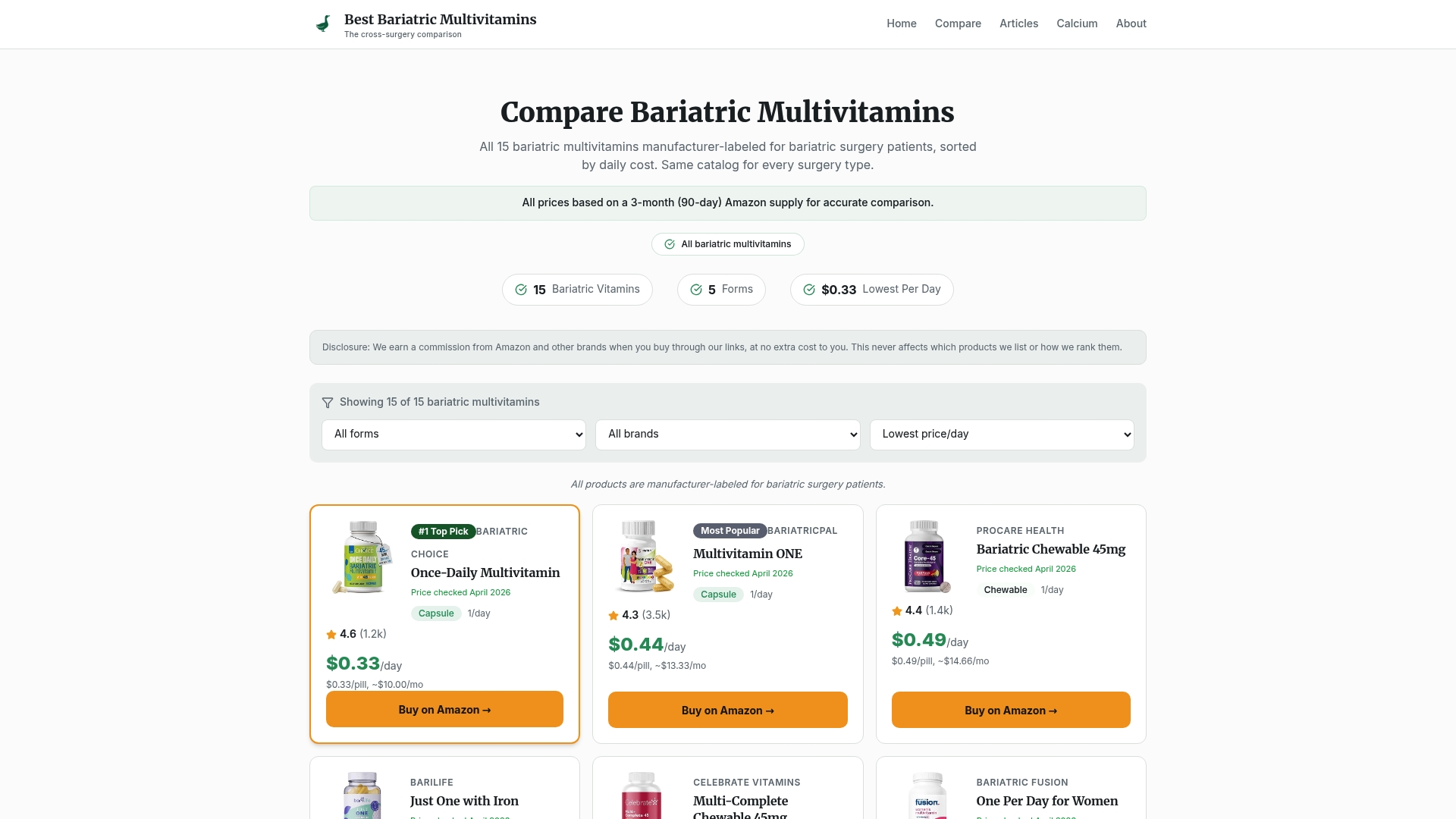
Every product reviewed on the site is evaluated against the ASMBS-referenced nutrient targets covered in this guide. You can see multivitamin price and ingredient comparisons filtered by your surgery type, so you’re not guessing whether a product actually covers your needs. Whether you’re newly post-op or years out and looking to reassess your regimen, the site’s tables give you a clear, honest starting point backed by the same standards your bariatric team uses.
Frequently asked questions
Why do nutrient needs change after different bariatric surgeries?
Each surgery type alters a different section of the digestive tract, which changes which vitamins and minerals are absorbed and how well. Bariatric vitamin needs differ by procedure, particularly for fat-soluble vitamins and key minerals like iron and zinc.
Do I need both a multivitamin and separate calcium after surgery?
Yes. Most bariatric multivitamins cannot fit the full recommended calcium dose in a single product, and calcium absorption is limited to roughly 650 mg at one time, requiring multiple doses spread throughout the day.
What happens if I use a generic, non-bariatric multivitamin instead?
Generic products typically lack the higher iron, B12, and fat-soluble vitamin doses required post-surgery. Specialized supplementation has been shown to reduce deficiency prevalence in bariatric patients, while generic labels often miss critical targets.
How often should my nutrient levels be checked post-surgery?
Your bariatric team will determine the schedule based on your procedure and risk profile. Real-world bariatric care programs typically recommend labs every 3 to 12 months, with more frequent checks in the first year.
Is there a single best bariatric multivitamin brand?
No single brand works for everyone. The right choice depends on your surgery type, current lab values, and whether you need standalone iron, calcium, or B12. Any one-size-fits-all chart is inherently limited for this reason.
Recommended
- Best Bariatric Multivitamins: Compare 15 Products by Price
- Bariatric Vitamin Guides for Bypass and Sleeve Patients
- Best Multivitamin After Gastric Bypass Surgery (2026)
- Best Multivitamin After Gastric Sleeve Surgery (2026)
Find your bariatric multivitamin
Compare 15 products by price, surgery type, and iron content.
Compare 15 multivitamins