
By David Gans · May 5, 2026

Pill size vs. form: What actually matters in bariatric vitamins
After bariatric surgery, it’s easy to get fixated on pill size. Smaller must be easier to swallow, right? Not exactly. The truth is that pill size is one of the least important factors in choosing a bariatric vitamin. What actually determines whether your supplement works for you is the delivery form, the nutrient amounts packed inside, and whether you can take it consistently every single day. This article breaks down what you really need to evaluate so you stop comparing millimeters and start comparing what matters.
Table of Contents
- Why pill size alone doesn’t tell the whole story
- Forms of bariatric vitamins: How options stack up
- How nutrient targets shape pill size and dosing
- What to prioritize when choosing bariatric vitamins
- The real bottom line: Why the fuss over pill size misses the mark
- Find your perfect fit: Compare bariatric vitamins by form, dosage, and price
- Frequently asked questions
Key Takeaways
| Point | Details |
|---|---|
| Form trumps size | Chewable or liquid vitamins are usually better-tolerated than large pills early post-op. |
| Meet micronutrient targets | Choose vitamins that fulfill surgery-specific guidelines for calcium, iron, B12, and other essentials. |
| Serving count affects ease | More servings per day can make tolerance easier but may become inconvenient if excessive. |
| No universal pill size | There’s no official guideline for maximum pill size; focus on what you can consistently take. |
| Adjust as you recover | Your ability to take different forms can evolve. What works in early weeks may change months later. |
Why pill size alone doesn’t tell the whole story
When patients first start researching bariatric vitamins, pill size comes up constantly. It shows up in Facebook groups, on product pages, and in conversations with other post-op patients. Brands even market their products around it, using phrases like “small, easy-to-swallow tablets.” The implication is that a smaller pill is automatically a better pill for bariatric patients.
That logic sounds reasonable. After surgery, your stomach is significantly smaller, your tolerance for anything large or hard is reduced, and nausea is a real concern in the early weeks. So it makes sense that patients would gravitate toward smaller options. But here is where the thinking goes sideways.
“For post-bariatric patients, the key issue with ‘pill size’ is less the millimeter size itself and more the supplement delivery form and how well the body can tolerate and absorb it in the early postoperative period.” Source: Endotext, NCBI Bookshelf
In other words, a tiny tablet that your altered digestive tract cannot properly absorb is far less useful than a slightly larger chewable that dissolves and absorbs efficiently. The conversation should not be about size. It should be about the bariatric vitamin delivery forms and whether they match your current stage of recovery.
Here is what actually matters when you evaluate a bariatric vitamin:
- Delivery form: Liquid, chewable, capsule, or tablet each behave differently in your altered GI tract
- Nutrient density: Can the serving size fit your daily targets without requiring 10 pills?
- Tolerability: Does the form cause nausea, GI distress, or difficulty swallowing?
- Compliance: Will you actually take it every day, long term?
- Absorption: Is the nutrient form bioavailable given your reduced stomach acid and altered anatomy?
None of those factors are measured in millimeters. That is the core point.
Forms of bariatric vitamins: How options stack up
If pill size is not the deciding factor, what is? Start with the delivery form. Each form has real trade-offs, and the best one for you depends heavily on where you are in your recovery.
Here is a practical overview of the four main forms:
-
Liquid vitamins: Easiest to tolerate in the first weeks post-op. No swallowing required, and absorption begins quickly. The downside is that liquids often taste strong, require refrigeration, and may not deliver enough of every nutrient in a single serving. You may need to supplement with additional products.
-
Chewable vitamins: The most commonly recommended form for the first three to six months after surgery. They dissolve before reaching your stomach, which improves absorption and reduces the risk of pill intolerance. Taste and texture vary significantly between brands, so finding one you actually enjoy matters for long-term compliance.
-
Capsules: Easier to swallow than hard tablets because the shell is soft and dissolves quickly. Capsules are a good middle ground for patients who have moved past the early recovery phase and want a more convenient option without committing to chewables long term.
-
Hard tablets: Generally not recommended in the early post-op period. They take longer to break down, and with reduced stomach acid after procedures like gastric bypass, full dissolution is not guaranteed. Some patients tolerate them well after six months or more, but they carry more risk than other forms early on.
Pro Tip: If you are not sure which form is right for your current stage, check out guidance on starting vitamins post-op to match your timing with the right product type.
Here is a simple comparison to help you visualize the differences:
| Form | Best stage | Absorption ease | Typical servings/day | Convenience |
|---|---|---|---|---|
| Liquid | Weeks 1 to 4 | High | 1 to 2 | Low (refrigeration) |
| Chewable | Months 1 to 6+ | High | 2 to 4 | Moderate |
| Capsule | Months 3+ | Moderate to high | 2 to 4 | High |
| Hard tablet | Months 6+ | Lower risk | 2 to 4 | High |
It is also worth knowing that pill identification basics can help you recognize what type of tablet or capsule you actually have, especially when switching between products or traveling with multiple supplements.
As your guideline-based targets show, nutrients like calcium citrate must be taken in divided doses, and specific ranges for B12, iron, and other micronutrients are non-negotiable. These requirements directly shape which form makes sense for you, because nutrients must fit into a manageable serving size without creating an overwhelming pill burden.
The bottom line here is that your form choice should evolve with your recovery. What works at week two will not necessarily be your best option at month twelve. Stay flexible, and pay attention to how your body responds.
How nutrient targets shape pill size and dosing
Here is something that surprises a lot of patients: the reason bariatric vitamins often require multiple servings per day has nothing to do with poor product design. It is a direct result of the nutrient targets you need to hit.
The recommended postoperative micronutrient targets are substantial:
- Oral or sublingual B12: 350 to 500 mcg per day
- Calcium citrate: 1,200 to 1,500 mg per day, taken in divided doses
- Iron: 18 mg per day minimum, up to 45 to 60 mg per day depending on your procedure or if you menstruate
- Vitamin D: 3,000 IU per day or more, adjusted based on labs
- Zinc, thiamine, folate: Each with their own specific targets
Now think about what it takes to pack all of that into a single small pill. It is physically impossible. Calcium alone is bulky. You cannot fit 500 mg of calcium citrate into a tiny tablet without making the tablet large. That is why calcium citrate options almost always come as separate supplements taken two to three times daily, rather than bundled into one multivitamin pill.

Here is how nutrient targets translate into real-world dosing:
| Nutrient | Daily target | Typical serving size | Servings needed/day |
|---|---|---|---|
| Calcium citrate | 1,200 to 1,500 mg | 500 mg per tablet | 2 to 3 |
| B12 (sublingual) | 350 to 500 mcg | 500 mcg per tablet | 1 |
| Iron | 18 to 60 mg | 18 to 45 mg per tablet | 1 to 2 |
| Vitamin D | 3,000+ IU | 2,000 IU per capsule | 1 to 2 |
| Multivitamin | Varies | Per product | 2 to 4 |
This is why “pill burden,” the total number of pills or servings you take each day, is such an important concept. High pill burden is one of the leading reasons patients fall out of compliance with their supplement routine. If your regimen requires eight separate pills at three different times of day, the odds that you will stick with it long term drop significantly.
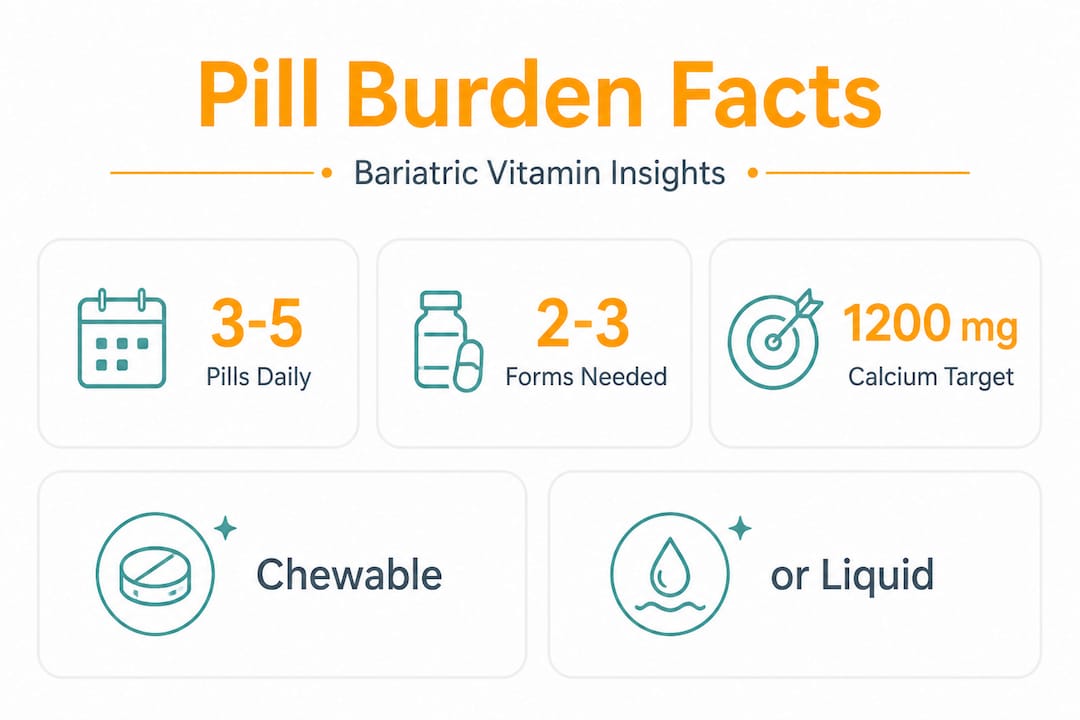
Understanding B12 dosage guidelines and calcium citrate specifics will help you see why some products are designed the way they are. It is not arbitrary. Every serving size reflects a real attempt to balance nutrient density with tolerability.
What to prioritize when choosing bariatric vitamins
Now that you understand why vitamins are formulated and dosed the way they are, here is a practical framework for making a smart choice. Use this as a checklist every time you evaluate a new product.
-
Check your nutrient targets first. Know what your procedure requires. Gastric bypass patients generally need higher iron than sleeve patients. Menstruating patients need more iron than non-menstruating patients. Start with your lab results and your surgeon’s recommendations, not the product label.
-
Assess your current tolerance. If you are in the first eight weeks post-op, a liquid or chewable is almost always the right call. Hard tablets are not worth the risk of intolerance or incomplete absorption at that stage.
-
Review serving size and frequency. Count how many pills or servings the product requires per day to hit your targets. A product that looks convenient might require four servings to deliver adequate nutrients, while another that looks more complex might hit your targets in two.
-
Look at the form of each nutrient. Calcium carbonate is not appropriate after gastric bypass because it requires stomach acid for absorption. Calcium citrate does not. This matters more than whether the tablet is round or oval.
-
Consider your lifestyle. Do you travel frequently? A chewable that requires refrigeration may not work for you. Are you sensitive to artificial sweeteners? Many chewables use them heavily.
-
Plan to transition. Your supplement needs will change as your recovery progresses. Build in a plan to reassess your regimen at three months, six months, and one year post-op.
Pro Tip: Use a site like bestbariatricmultivitamins.com to compare bariatric multivitamins side by side on iron content, form, price per day, and surgery type fit. It saves hours of research and helps you spot gaps in nutrient coverage at a glance.
Warning signs that your current supplement is a poor fit:
- Difficulty swallowing or gagging on tablets
- Consistent nausea after taking your vitamins
- Skipping doses because of taste or inconvenience
- Lab results showing deficiencies despite taking your vitamins
If any of those apply to you, do not just push through. Talk to your bariatric care team about switching forms. Compliance matters more than brand loyalty. You can also review avoiding vitamin deficiencies for a deeper look at what happens when nutrient gaps go unaddressed.
Rather than comparing pill dimensions across brands, post-op patients are better served by comparing nutrient targets, required units per day, and whether the form matches their tolerance. That is the framework that actually protects your health.
The real bottom line: Why the fuss over pill size misses the mark
I am David Gans, and I had gastric bypass in January 2024. I lost 231 lbs, and I also spent the first few weeks post-op obsessing over which vitamins were the smallest. I was convinced that a tiny pill would be easier on my new stomach. What I did not understand at the time was that the size of the pill was almost irrelevant compared to whether I was actually hitting my nutrient targets and whether the form I chose was one I could tolerate and take consistently.
Here is what I have come to believe after going through this process and spending the past year researching bariatric supplements: the conversation about pill size is largely a distraction. It is understandable, because swallowing anything feels daunting in those early weeks. But it pulls patients away from the questions that actually determine outcomes.
There is no standardized prescription for bariatric pill dimensions in any major clinical guideline. Not one. What guidelines do specify are nutrient targets. Clinicians then translate those targets into patient-manageable formulations, which is why your care team might recommend a specific brand or form rather than a specific pill size.
What I always tell people is this: start with a chewable or liquid in the early weeks, take your labs seriously at the three-month mark, and be willing to adjust. I switched from chewables to capsules at around month five because I was traveling more and the chewables were inconvenient. My labs stayed solid because I chose a capsule that hit the same nutrient targets, not because I found a smaller pill.
The practical takeaway is simple. As your recovery progresses, your options open up. You do not have to stay on chewables forever. But the transition should be driven by your tolerance, your labs, and your lifestyle, not by a desire for a more convenient pill size. Browse the in-depth bariatric vitamin guides on this site to see how different products actually compare on the metrics that matter.
Find your perfect fit: Compare bariatric vitamins by form, dosage, and price
Choosing the right bariatric vitamin does not have to feel overwhelming. At Bestbariatricmultivitamins.com, we have done the comparison work for you.
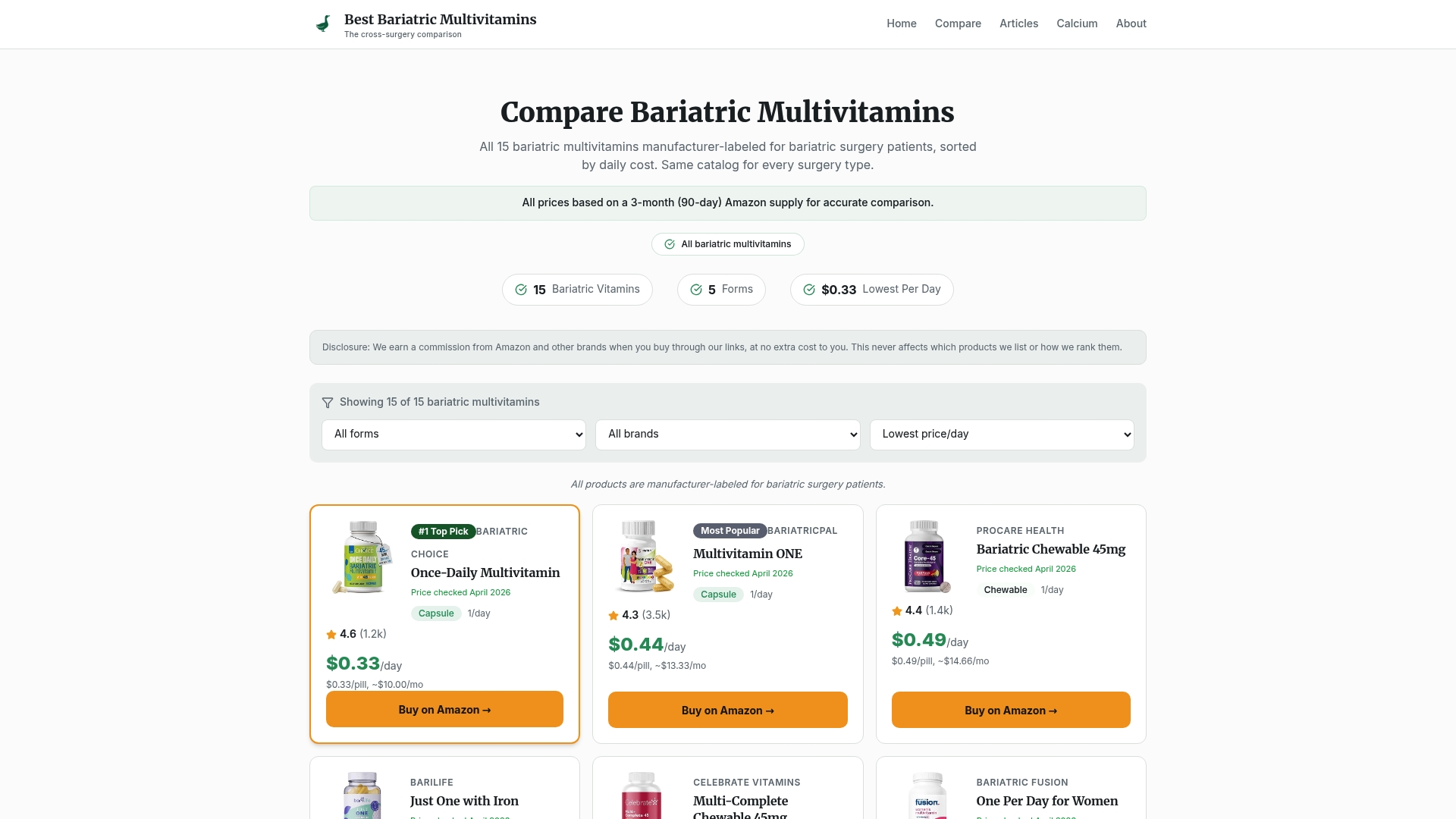
We compare bariatric vitamins across 15 manufacturer-labeled products, breaking down price per day, iron content, delivery form (capsule, chewable, dissolvable), and surgery type fit for gastric bypass, sleeve, and mini-bypass patients. Whether you are in week two post-op or two years out and looking to optimize, our bariatric supplement comparison tool makes it easy to find the product that fits your targets, your tolerance, and your budget. No guesswork. No winging it. Just clear, patient-centered comparisons built from real post-op experience.
Frequently asked questions
Can I crush or split bariatric vitamin pills if they feel too large?
Most bariatric vitamin pills can be crushed or split, but check with your pharmacist first to confirm it will not affect absorption or release mechanisms. Many patients find it easier to start with chewable or liquid forms and transition to tablets later.
How many pills or servings a day should I expect to take after bariatric surgery?
Expect to take multiple servings daily to reach your targets. Guideline-based targets include calcium citrate at 1,200 to 1,500 mg per day in divided doses, B12 at 350 to 500 mcg per day, and iron at 18 to 60 mg per day depending on your procedure and whether you menstruate.
Are smaller pills less effective than larger ones post-bariatric surgery?
No. Effectiveness depends on nutrient composition and bioavailability, not physical size. As Endotext notes, the key issue is delivery form and tolerability, so the best pill is simply the one you can take consistently and absorb well.
Is there an official maximum size bariatric patients should avoid?
No official maximum pill size exists in major clinical guidelines. As guideline tables confirm, there is no standardized prescription for bariatric pill dimensions. Clinical focus stays on nutrient targets, delivery form, and individual patient tolerance.
Recommended
- Best Bariatric Multivitamins: Compare 15 Products by Price
- Does Insurance Cover Bariatric Vitamins? What You Need to Know
- Bariatric Vitamin Guides for Bypass and Sleeve Patients
- Gummy Vitamins After Bariatric Surgery: Why They Fall Short
- supplement fillers and what they do
Find your bariatric multivitamin
Compare 15 products by price, surgery type, and iron content.
Compare 15 multivitamins