
By David Gans · May 7, 2026

Post-op multivitamin transition guide for bariatric patients
You know you need specialized vitamins after surgery, but moving from chewables to tablets, managing calcium on its own schedule, and figuring out iron timing feels genuinely overwhelming. Most discharge packets hand you a list without explaining why each rule exists, and that gap is where deficiencies start. This guide walks you through every step of the transition process in plain language, covering which supplement forms to use, when to switch, how to keep calcium and iron from sabotaging each other, and how to read labs so you can stay ahead of problems before your body catches up with you.
Table of Contents
- Understanding your unique post-op vitamin needs
- What you need for a successful multivitamin transition
- Step-by-step transition: Multivitamins, calcium and iron
- Common pitfalls and troubleshooting tips
- What to expect: Monitoring, results, and adjustments
- The uncomfortable truth about post-op vitamin transitions
- Compare and choose your post-op vitamins confidently
- Frequently asked questions
Key Takeaways
| Point | Details |
|---|---|
| Match vitamins to your procedure | Choose supplements based on your specific surgery type and guideline micronutrient needs. |
| Separate calcium and iron doses | Take calcium citrate and iron at different times to maximize absorption and effectiveness. |
| Start with chewables, transition as you tolerate | Begin with easily absorbed forms and move to tablets when your pouch allows. |
| Monitor labs, adjust regimen | Regular blood tests help prevent deficiencies and guide your supplement choices. |
| Generic vitamins often fall short | Look for bariatric-specific formulas that guarantee the right nutrient levels for your recovery. |
Understanding your unique post-op vitamin needs
Bariatric surgery doesn’t just shrink your stomach. Depending on your procedure, it also changes how your intestine absorbs micronutrients (vitamins and minerals your body needs in small amounts). That distinction matters enormously when you’re choosing a multivitamin.
Procedure-specific vitamin needs vary because some surgeries are purely restrictive (like the gastric sleeve or lap band), while others are malabsorptive, meaning they reroute digestion so your small intestine absorbs less. The more malabsorptive your surgery, the higher your micronutrient targets.
Key insight: Postoperative supplementation targets are procedure-dependent, with significantly higher doses required for hypoabsorptive operations like BPD/DS (biliopancreatic diversion with duodenal switch).
Here are the core nutrients every post-op bariatric patient must track:
- Thiamine (B1): Critical in the first months; deficiency causes serious neurological damage
- Vitamin B12: Intrinsic factor (a protein needed for B12 absorption) is reduced after gastric bypass
- Folate: Essential for cell production; risk is elevated in malabsorptive procedures
- Iron: Absorption drops sharply after bypass because the duodenum (first part of the small intestine) is bypassed
- Vitamin D (25-OH): Fat-soluble; commonly deficient, especially after malabsorptive surgery
- Vitamin A: Fat-soluble; deficiency risk is highest after BPD/DS
- Vitamin K: Also fat-soluble; often overlooked but important for bone and clotting health
- Calcium: Requires separate supplementation in virtually all bariatric procedures
After bariatric surgery, patients are typically maintained on a high-potency multivitamin with minerals plus separate calcium. Understanding these needs upfront is what separates patients who stay healthy from those who discover deficiencies at the 12-month labs. Review vitamin deficiency risks in detail so you know the warning signs before they escalate.
| Surgery type | Malabsorption level | Key extra risks |
|---|---|---|
| Lap band (LAGB) | None | Thiamine if eating is severely restricted |
| Gastric sleeve (SG) | Minimal | B12, iron (mild) |
| Gastric bypass (RYGB) | Moderate | B12, iron, calcium, vitamin D |
| Mini-bypass (OAGB) | Moderate-high | B12, fat-soluble vitamins |
| BPD/DS | High | All fat-soluble vitamins, iron, B12 at highest risk |
Browse our vitamin supplement guides if you want a procedure-specific deep dive on any of these categories.
What you need for a successful multivitamin transition
Before you switch anything, gather the right materials and confirm you’re ready. Jumping to tablets too soon, or relying on a generic store-brand multivitamin, are the two fastest ways to create a deficiency you won’t notice for months.
What to have on hand before you start:
- Your surgeon’s discharge instructions and any specific micronutrient targets
- A bariatric-specific chewable or liquid multivitamin for the first weeks
- Calcium citrate (not calcium carbonate) supplements dosed separately
- A printed copy of your most recent lab results
- A simple daily pill organizer to manage timing
Chewable multivitamins are recommended immediately post-op, with transition to tablets only as your pouch tolerates solid forms and when micronutrient targets are confirmed by labs. Most programs clear patients for tablets anywhere between 4 and 8 weeks post-op, but this varies.

Choosing the right product form:
| Form | Best for | Pros | Cons |
|---|---|---|---|
| Chewable | First 4-8 weeks post-op | Easy to tolerate, fast dissolve | May taste sweet, some don’t meet full targets |
| Dissolvable/sublingual | Any stage | High absorption, bypasses stomach acid concerns | More expensive |
| Capsule | 6+ weeks, confirmed tolerance | Easy to swallow once tolerating, precise dosing | Requires full capsule swallowing |
| Tablet | 6-8+ weeks | Cost-effective, high-potency options | Hardest to switch to, check coating |
| Gummy | Not recommended | Palatable | Rarely meet bariatric micronutrient targets |
Pro Tip: Check your bariatric multivitamin choices carefully. Look for a label that lists at least 100% DV of thiamine, B12 at 500 mcg or higher, and 18 mg or more of iron (for menstruating women or bypass patients). Generic “one-a-day” style vitamins almost never meet these thresholds.
Read about vitamin timing after surgery to understand exactly when to begin each supplement in the post-op timeline. And if your procedure was a sleeve, your targets will differ from bypass patients, so check the gastric sleeve multivitamin guide specifically.
Step-by-step transition: Multivitamins, calcium and iron
Here’s the practical framework that works for most bariatric patients, based on ASMBS guideline recommendations. Use this as a starting framework, then adjust with your care team’s guidance.
Step 1: Start chewable multivitamins within days of surgery Your surgical team will clear you for liquids and soft chewables quickly. Begin a bariatric-specific chewable multivitamin as soon as your program approves it, usually within the first few days. Take it with a small amount of food to reduce nausea.
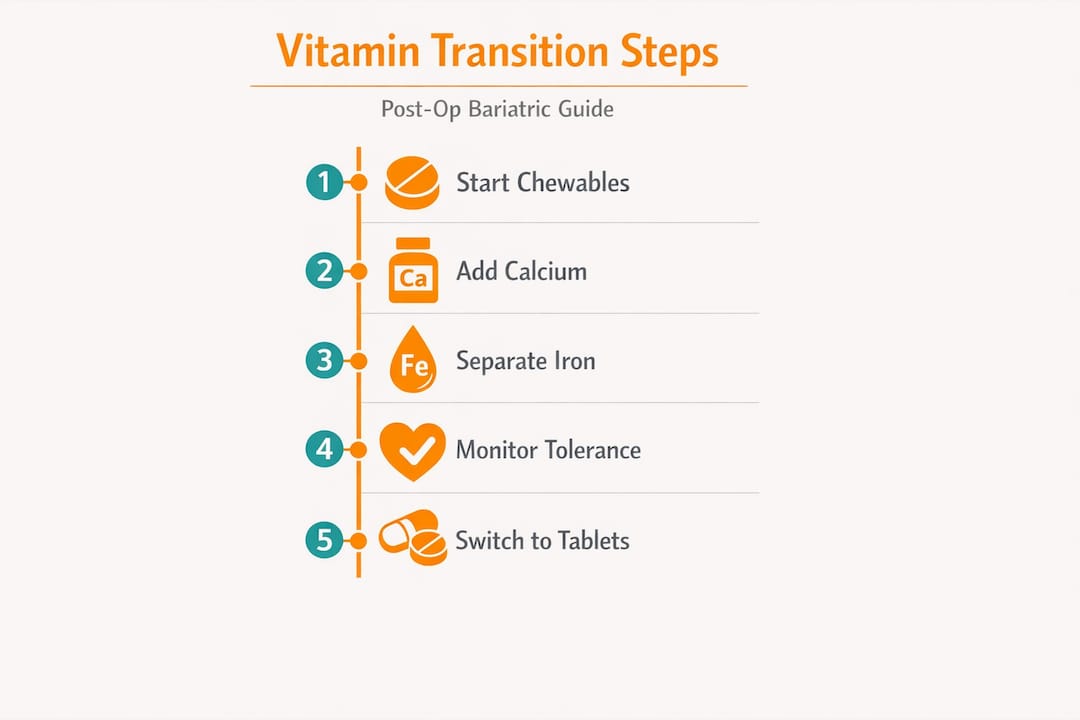
Step 2: Add calcium citrate immediately, in divided doses Multivitamins do not contain recommended doses of calcium, so separate calcium citrate in divided doses is required from day one. Target 1200 to 1500 mg per day for sleeve and bypass patients, and up to 2400 mg daily for BPD/DS patients. Split calcium into 2 to 3 doses across the day because your body can only absorb about 500 mg of calcium at one time.
Step 3: Schedule iron separately from calcium Calcium impairs iron absorption, so take these two supplements at different times of day. Many patients take iron with breakfast and calcium citrate with lunch and dinner. If your provider recommends it, pair iron with 250 mg of vitamin C (ascorbic acid) to boost absorption by up to 60%.
Step 4: Monitor for at least 3 to 4 weeks before switching forms Watch for GI tolerance (bloating, nausea, constipation) and confirm your labs are trending well before moving to tablets or capsules. Don’t rush this step.
Step 5: Transition to a higher-potency tablet or capsule formula Once you’ve cleared the 4 to 6 week mark and your care team approves, switch to a pharmaceutical-grade bariatric tablet that meets full ASMBS micronutrient targets. Use your labs as your guide, not just your symptom level.
Step 6: Build a sustainable daily schedule
A simple daily structure that works well:
- Morning: Multivitamin + iron (with vitamin C)
- Midday: Calcium citrate (500 mg dose)
- Evening: Calcium citrate (500 mg dose), vitamin D if separate
Important: Never take calcium and iron at the same time. The gap between these two supplements should be at least 2 hours to protect iron absorption. For deficiency warning signs that might indicate your timing is off, watch for fatigue, hair thinning, or cold intolerance.
Review calcium citrate options that pair well with your multivitamin, and check the B12 supplementation tips article if your serum B12 is below 400 pg/mL.
Common pitfalls and troubleshooting tips
Even motivated patients make the same preventable mistakes. Here’s what I see most often, and how to fix it.
The biggest mistakes bariatric patients make:
- Using generic store-brand multivitamins. ASMBS-aligned dosing requires higher amounts of specific nutrients than standard formulas provide. Unless the label explicitly confirms it meets bariatric targets, assume it doesn’t.
- Skipping calcium supplementation. Bone density loss after bariatric surgery is real and silent. You won’t feel it happening. By the time a DEXA scan (bone density test) shows loss, the damage has been building for years.
- Taking iron and calcium together. This is one of the most common errors. Many patients take all their supplements at once in the morning. Calcium blocks iron absorption at the intestinal level, which means your ferritin (stored iron) will drop even if you’re taking the right dose.
- Switching to gummies. This deserves a direct callout. Gummy vitamins after surgery are almost universally underdosed for bariatric patients. They taste great, but they rarely contain iron at all, and their B12 and D levels often fall far below bariatric targets.
- Skipping lab monitoring. Symptoms of deficiency often appear late. Low serum B12 or ferritin may not cause noticeable symptoms until levels are significantly depleted.
Pro Tip: Set a phone reminder for your lab appointment dates. In the first post-op year, labs every 3 to 6 months are standard. Don’t wait for symptoms to prompt testing.
A note on statistics: Studies consistently show that nutritional deficiencies affect 30% to 50% of bariatric patients within the first two years, with iron, vitamin D, and B12 topping the list. Consistent supplementation and lab monitoring are the two factors most strongly associated with staying deficiency-free.
What to expect: Monitoring, results, and adjustments
Good supplementation is not a set-it-and-forget-it system. Your absorption efficiency, dietary habits, and body composition change significantly in the first 12 to 18 months after surgery. Labs tell you whether your regimen is actually working.
Key labs to track and their targets:
- Serum B12: Aim for above 400 pg/mL; below 200 is deficient
- Ferritin: Best iron storage marker; aim for 50 to 100 ng/mL
- 25-OH vitamin D: Target 30 to 60 ng/mL; many providers aim for 40+
- Serum calcium: Usually stays normal even when intake is low (your body pulls from bone), so track alongside PTH (parathyroid hormone)
- Vitamin A (retinol): Especially critical after BPD/DS
- Vitamin K: Track if you have bone loss concerns or are on anticoagulants
You should adjust individual components such as iron, B12, and fat-soluble vitamins based on your labs and procedure type, not just a standard template. One patient’s RYGB regimen may need double the iron dose of another’s if menstruation or poor dietary compliance is a factor.
| Lab marker | Deficient | Borderline | Optimal target |
|---|---|---|---|
| Serum B12 | Below 200 pg/mL | 200-400 pg/mL | Above 400 pg/mL |
| Ferritin | Below 15 ng/mL | 15-30 ng/mL | 50-100 ng/mL |
| 25-OH vitamin D | Below 20 ng/mL | 20-30 ng/mL | 40-60 ng/mL |
| Vitamin A (retinol) | Below 20 mcg/dL | 20-30 mcg/dL | 30-70 mcg/dL |
Use these benchmarks when you review labs with your provider. If your numbers are sliding, that’s your signal to monitor for deficiencies proactively and adjust before symptoms appear. Tracking B12 levels in particular is worth doing consistently because neurological symptoms from deficiency can be subtle and are sometimes misattributed to other causes.
The uncomfortable truth about post-op vitamin transitions
I am David Gans. I had gastric bypass in January 2024 and lost 231 lbs. And I will tell you something most transition guides won’t: a standardized plan is a starting point, not a solution.
The problem with most “transition guides” is that they treat all bariatric patients as one category. They don’t. A sleeve patient three months out with normal labs has almost nothing in common nutritionally with a BPD/DS patient 18 months out whose vitamin A has quietly dropped to deficient. The same chewable-to-tablet progression timeline doesn’t apply to both.
Generic vitamins and gummies are the second big issue. Patients choose them because they’re convenient and cheap, and because the marketing language sounds credible. But unless the label shows iron at 18 mg or higher, B12 at 500 mcg or more, and a full fat-soluble vitamin panel, that product doesn’t belong in a post-bariatric cabinet. Period. I made the mistake of winging it with a grocery store brand for six weeks before my 90-day labs came back with ferritin at 11. That was a correctable problem, but only because I caught it early.
The other truth: most patients need periodic reassessment, not just annual labs. Your absorption efficiency changes as your pouch matures. What was adequate at 6 months may underdose you at 18 months if your diet has slipped or your body composition has shifted significantly. Label vigilance and regular routine deficiency checks are the practical habits that keep patients out of trouble long term. Your healthcare provider is your essential partner here, not a quarterly box-check.
Compare and choose your post-op vitamins confidently
You now have a clear picture of what your post-op body needs and why getting the details right matters so much. The next practical step is finding products that actually match those targets.
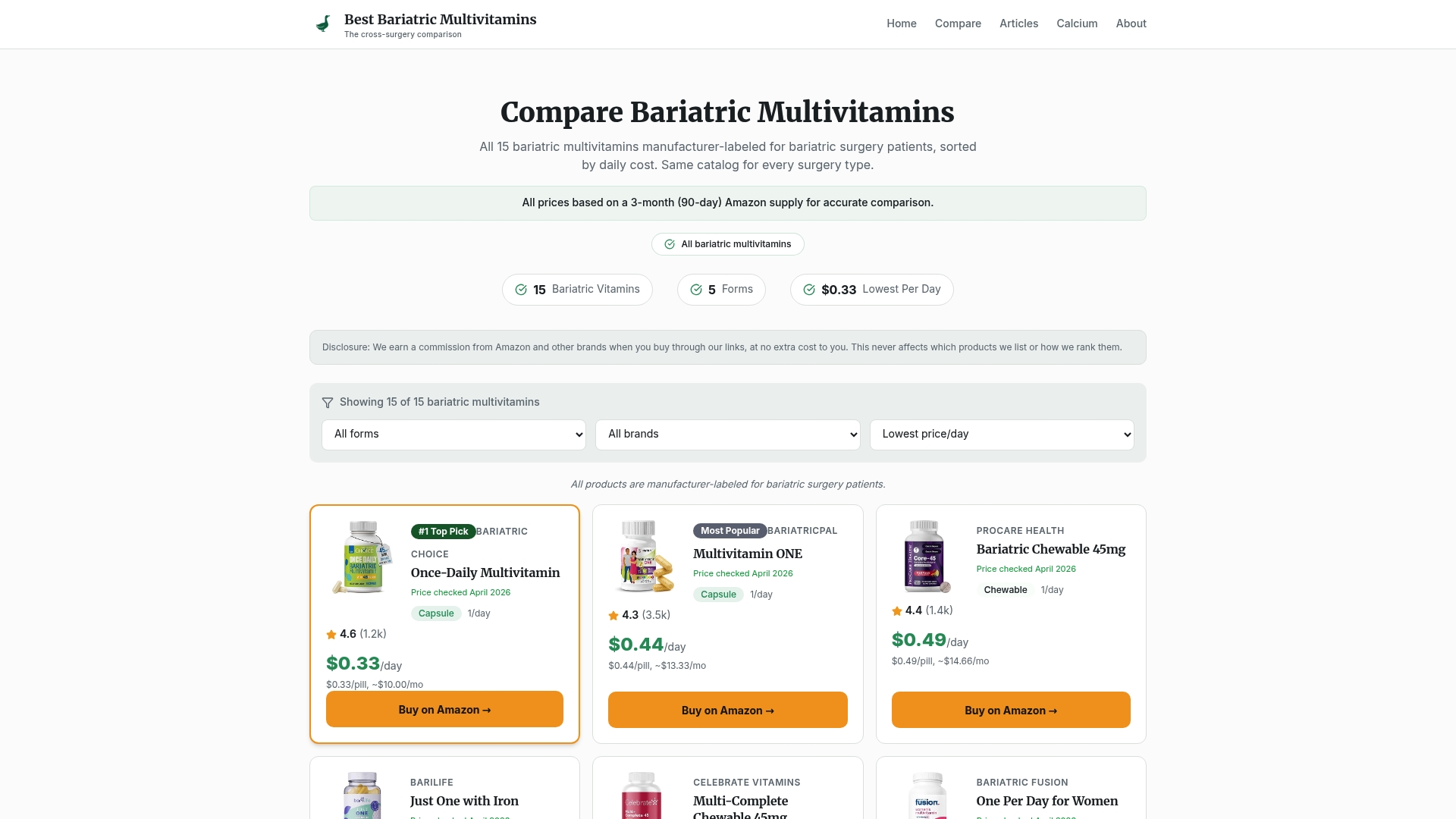
At Bestbariatricmultivitamins.com, we’ve done the comparison work for you. Our bariatric multivitamin comparison covers 15 manufacturer-labeled products, evaluated on price per day, iron content, form (chewable, capsule, dissolvable), and surgery type fit. You can filter by procedure and see at a glance which products hit ASMBS micronutrient targets and which fall short. For calcium, our calcium citrate comparison helps you find the right dose and form to pair with your multivitamin without overpaying. Use these tools to build a regimen that’s specific to your surgery, your labs, and your budget.
Frequently asked questions
How soon after surgery should I start multivitamins?
Most bariatric programs recommend starting chewable multivitamins immediately post-op, typically within a few days of surgery, but always follow your surgeon’s specific instructions.
Can I use regular multivitamins after surgery?
You can use regular multivitamins only if they meet ASMBS micronutrient targets; most do not, so pharmacy-grade bariatric formulas are strongly preferred to avoid gaps in critical nutrients.
Why do I need separate calcium supplementation?
Multivitamins don’t contain the recommended calcium dose for bariatric patients, so separate calcium citrate is necessary to meet your 1200 to 2400 mg daily target depending on your procedure.
Can I take iron and calcium together?
No. Calcium impairs iron absorption at the intestinal level, so separate these supplements by at least 2 hours to protect your ferritin levels.
How often should labs be checked after bariatric surgery?
Your doctor will typically monitor labs every 3 to 6 months in the first year, then at least annually, using results to personalize your supplement adjustments over time.
Recommended
- Best Bariatric Multivitamins: Compare 15 Products by Price
- Best Multivitamin After Gastric Bypass Surgery (2026)
- Bariatric Vitamin Guides for Bypass and Sleeve Patients
- Bariatric Vitamin Deficiencies: What to Watch For
- guidance on multivitamin intake patterns
Find your bariatric multivitamin
Compare 15 products by price, surgery type, and iron content.
Compare 15 multivitamins