
By David Gans · May 3, 2026

Smart cost-per-day vitamin comparison for bariatric patients
Spending less on vitamins sounds smart until your labs come back flagging low ferritin, dropping serum B12, or deficient 25-OH vitamin D six months after surgery. For the 256,000+ Americans who undergo bariatric surgery each year, the cheapest supplement on the shelf is rarely the most cost-effective choice. True value after gastric bypass or sleeve means covering every bariatric-specific nutritional target, not just finding the lowest price tag. This guide breaks down how to compare vitamin regimens safely and economically, using real evidence and practical math you can actually use.
Table of Contents
- Why cost-per-day vitamin comparisons matter for bariatric patients
- What sets bariatric vitamin needs apart?
- How to calculate true cost-per-day for bariatric vitamins
- Common pitfalls in vitamin cost comparisons (and how to avoid them)
- The real-world math: Why the cheapest option often isn’t safe or best
- Find your safest, best-value bariatric vitamin plan
- Frequently asked questions
Key Takeaways
| Point | Details |
|---|---|
| Include every required nutrient | Always factor calcium, vitamin D, iron, and B12 into your daily cost, not just the multivitamin. |
| Higher needs post-surgery | Bariatric surgery raises your nutrient requirements far above standard supplements. |
| Bundle for an accurate comparison | Compare monthly or daily costs only after building a full regimen based on your type of surgery and lab results. |
| Personalization is key | Your best-value plan depends on surgery type, lab results, and working with your provider. |
| Lowest cost isn’t always best | Cutting corners may save pennies but can risk expensive health issues later. |
Why cost-per-day vitamin comparisons matter for bariatric patients
After bariatric surgery, your gut absorbs nutrients very differently than it did before. Your stomach is smaller, your digestive tract is rerouted (in the case of gastric bypass), and your body’s ability to extract vitamins and minerals from food is significantly reduced. That makes supplementation non-negotiable, and it makes choosing the right supplement genuinely high-stakes.
Many patients focus on price-per-day as the primary filter when shopping for vitamins. That instinct makes sense. You are managing a budget, and supplements are an ongoing expense. But a cost-per-day figure is only meaningful when the product actually meets your needs. As post-op supplementation guidelines make clear, a bariatric vitamin cost-per-day comparison is only meaningful if the product and any separate supplements like calcium and iron match bariatric-specific nutritional requirements rather than simply being the cheapest per day.
A $0.50/day multivitamin that leaves you deficient in iron or B12 will cost you far more in lab retests, doctor visits, IV infusions, or lost energy and hair than a $1.50/day regimen that actually works.
Here is what under-supplementing can lead to over time:
- Iron deficiency anemia, causing fatigue, shortness of breath, and hair loss
- Vitamin B12 deficiency, leading to nerve damage and cognitive changes
- Calcium and vitamin D deficiency, increasing risk of osteoporosis and bone fractures
- Thiamine (B1) deficiency, which can cause serious neurological complications
- Zinc deficiency, contributing to poor wound healing and prolonged hair thinning
Understanding vitamin deficiencies after bariatric surgery is the foundation for any smart cost comparison. Without that context, you are just comparing numbers that don’t tell the full story.
What sets bariatric vitamin needs apart?
Standard adult multivitamins are formulated for people with fully functional digestive systems eating a balanced diet. That is not you after bariatric surgery, and that gap matters enormously when you are trying to compare products by price.
The NCBI post-op supplementation table outlines targets that are dramatically higher than what you find in a typical drugstore multivitamin. Here is a snapshot of key post-bariatric nutrient targets:
| Nutrient | Standard adult RDA | Post-bariatric target |
|---|---|---|
| Thiamine (B1) | 1.1–1.2 mg/day | 12 mg/day |
| Vitamin B12 | 2.4 mcg/day | 350–500 mcg/day orally |
| Iron (general) | 8–18 mg/day | 18 mg/day minimum |
| Iron (RYGB/sleeve/menstruating) | 18 mg/day | 45–60 mg/day |
| Calcium | 1,000 mg/day | 1,200–1,500 mg/day as citrate |
| Vitamin D3 | 600–800 IU/day | 3,000 IU/day |
The differences are not minor. Post-bariatric thiamine needs are roughly 10 times higher. B12 requirements are more than 100 times the standard RDA. Iron needs for menstruating women after gastric bypass or sleeve can be three times higher than the standard recommendation.

This is why finding the ideal multivitamin after gastric bypass requires looking beyond generic labels. And it is also why bypass vs sleeve vitamin needs differ enough that your surgery type should directly influence which products you buy.
A few additional points worth knowing:
- Calcium must be citrate form, not carbonate. After gastric bypass especially, stomach acid is reduced, and calcium carbonate requires acid to absorb properly. Calcium citrate does not.
- Iron and calcium should not be taken together. They compete for absorption, so timing matters as much as dosing.
- Menstruating women after RYGB or sleeve need significantly more iron than men or post-menopausal women, which affects both product selection and total monthly cost.
Pro Tip: Before you compare any vitamin prices, write down your surgery type, your most recent lab values for ferritin, serum B12, 25-OH vitamin D, and zinc, and whether you are still menstruating. These three factors alone will determine which products are actually worth comparing for you.
How to calculate true cost-per-day for bariatric vitamins
Here is where most patients go wrong. They see a bariatric multivitamin priced at $0.80 per day and think they have found a deal. But that multivitamin might not include enough calcium, might use calcium carbonate instead of citrate, and might fall short on iron for their specific surgery type. So they end up buying separate calcium citrate, additional iron, and extra B12 anyway, and the real daily cost climbs to $1.80 or more.
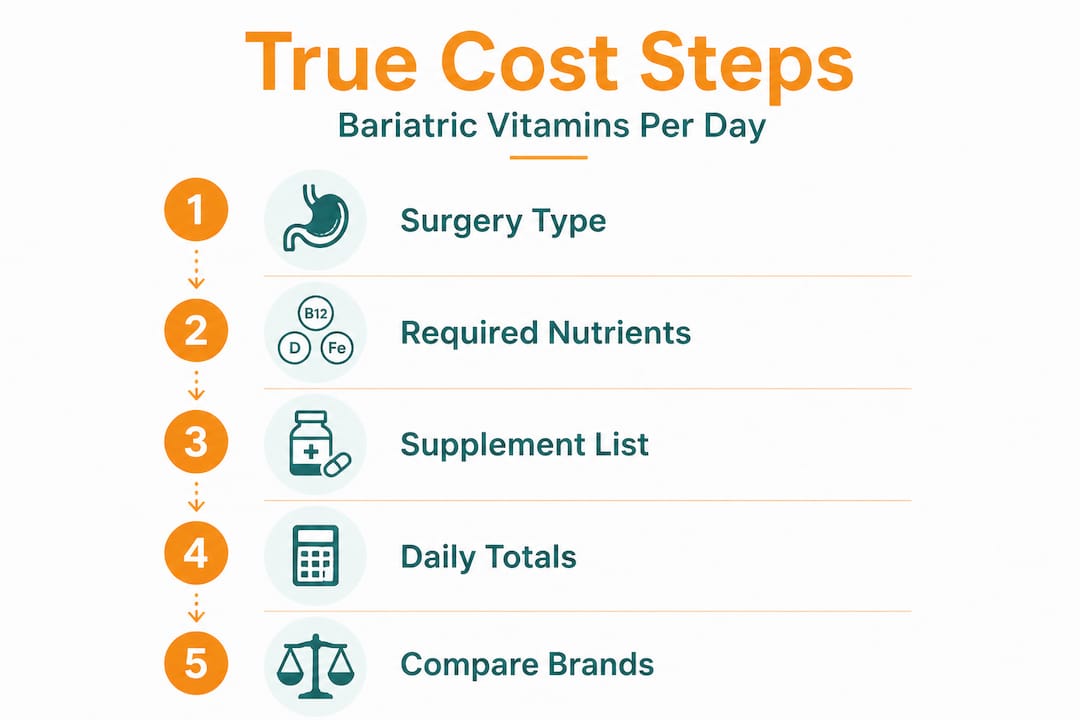
Post-op bariatric supplementation almost always involves a daily multivitamin plus separate components, not just a multivitamin alone. A true cost-per-day requires bundling your multivitamin with calcium citrate and vitamin D, plus additional iron or B12 depending on your labs and surgery type.
Follow these steps to build an accurate cost estimate:
- List every supplement you need. Start with your bariatric multivitamin, then add calcium citrate (usually 1,200–1,500 mg/day in split doses), vitamin D3 if not covered, and iron or B12 if your labs or surgery type require higher doses.
- Find the monthly cost of each product. Divide the bottle price by the number of days it covers. Do this for every item in your regimen.
- Add them all together. This is your true monthly cost.
- Divide by 30 to get your real cost-per-day.
- Check nutrient coverage. Confirm the combined regimen actually hits bariatric targets for thiamine, B12, iron, calcium citrate, and vitamin D3.
Here is a simplified comparison of what two different regimens might look like:
| Regimen | Multivitamin | Calcium citrate | Extra iron | Monthly total |
|---|---|---|---|---|
| Budget option | $12/month | $10/month | $8/month | ~$30/month |
| Mid-range bariatric brand | $25/month | Included | Included | ~$25/month |
| Premium bariatric bundle | $40/month | Included | Included | ~$40/month |
As a ballpark, monthly supplement costs for bariatric patients, covering multivitamins plus calcium and iron, often fall in the $20 to $60 per month range depending on brand and individual needs. The key insight here is that a mid-range all-in-one bariatric product can actually be cheaper than piecing together a budget multivitamin with all the separate add-ons.
Pro Tip: Use a simple spreadsheet or even a notes app on your phone to track every supplement you take, its monthly cost, and the nutrient amounts it provides. Update it after every lab check. This makes your next cost comparison much faster and more accurate.
You can compare bariatric multivitamin prices side by side across 15 labeled bariatric brands, filtered by surgery type, iron content, and form, which makes this bundling math a lot easier. And if you are still unsure about calcium forms, the breakdown of why calcium citrate matters is worth reading before you buy.
Common pitfalls in vitamin cost comparisons (and how to avoid them)
Even when patients understand the bundling concept, there are still common mistakes that lead to wasted money or, worse, undetected deficiencies. Here is what to watch out for:
- Pricing only the multivitamin and ignoring calcium and iron. This is the most frequent error. The multivitamin is just one piece of the puzzle.
- Choosing calcium carbonate over calcium citrate to save money. Calcium carbonate is cheaper, but after gastric bypass it absorbs poorly due to reduced stomach acid. You end up paying for something your body cannot use effectively.
- Buying general adult multivitamins because they are cheaper. A standard Centrum or One-A-Day costs less per day, but it does not come close to meeting post-op bariatric targets for iron, B12, thiamine, or calcium. The lower price does not reflect lower value; it reflects lower coverage.
- Not adjusting your plan based on lab results. Your needs change. If your ferritin drops, you may need to add a separate iron supplement. If your 25-OH vitamin D is low despite supplementation, you may need a higher D3 dose. Sticking with the same regimen regardless of labs is winging it, and your body will catch up with you eventually.
- Overlooking form and tolerability. Chewable vitamins, capsules, and dissolvables all have different absorption profiles and tolerability levels post-op. A product you cannot tolerate is a product you will stop taking, making its cost-per-day effectively infinite.
It is also worth knowing that gummy vitamins after bariatric surgery are generally not recommended because they lack adequate iron and often contain sugar alcohols that cause GI distress. Many patients choose them because they taste good and seem affordable, but they usually require additional supplementation that erases any cost advantage.
Timing matters too. Knowing when to start vitamins after surgery affects both your recovery and your budget planning. Starting the right regimen early prevents the need for catch-up supplementation later, which can be significantly more expensive.
Pro Tip: Before switching to a cheaper vitamin, run your current and proposed regimens through a nutrient comparison. Check that the new option still meets bariatric targets for iron, calcium citrate, B12, thiamine, and vitamin D3. If it falls short in even one area, factor in the cost of the add-on supplement before declaring it a better deal.
The real-world math: Why the cheapest option often isn’t safe or best
I am David Gans, and I lost 231 lbs after gastric bypass in January 2024. In my first few months post-op, I made the same mistake many patients make. I looked at vitamin prices and gravitated toward the lower end because I was already managing new food costs, gym costs, and follow-up appointment costs. It felt like a reasonable place to cut back.
What I did not fully appreciate at the time was that a low-cost vitamin that skips on iron or uses the wrong calcium form is not actually saving you money. It is deferring a cost that will show up later in your labs, your energy levels, your hair, and potentially your bone density. Treating iron deficiency anemia with IV iron infusions costs hundreds of dollars per session. That is a much more painful expense than spending an extra $15 a month on a regimen that actually works.
The smarter approach is to think of your vitamin regimen as a monthly insurance payment. You are not just buying nutrients; you are protecting the investment you made in surgery. The vitamin guides for bypass and sleeve I have written are built around this principle: find the best value that still meets every clinical target, not the lowest price that leaves gaps.
Here is the contrarian truth that most bargain-focused articles will not tell you: a mid-range bariatric-specific product that covers all your nutrient targets in one bottle is almost always a better financial decision than a cheap general multivitamin plus three separate add-ons. The math usually works out in favor of the purpose-built product, and the clinical safety margin is far better.
The best vitamin plan for you is personalized. It accounts for your surgery type, your current labs, your iron needs, your calcium form, and your tolerability. That personalization is not a luxury. It is what makes cost comparisons meaningful in the first place.
Find your safest, best-value bariatric vitamin plan
Ready to put this framework into practice? At Bestbariatricmultivitamins.com, we have done the bundling math for you across 15 bariatric-specific multivitamin brands, comparing them on price per day, iron content, calcium form, supplement form, and surgery type fit.
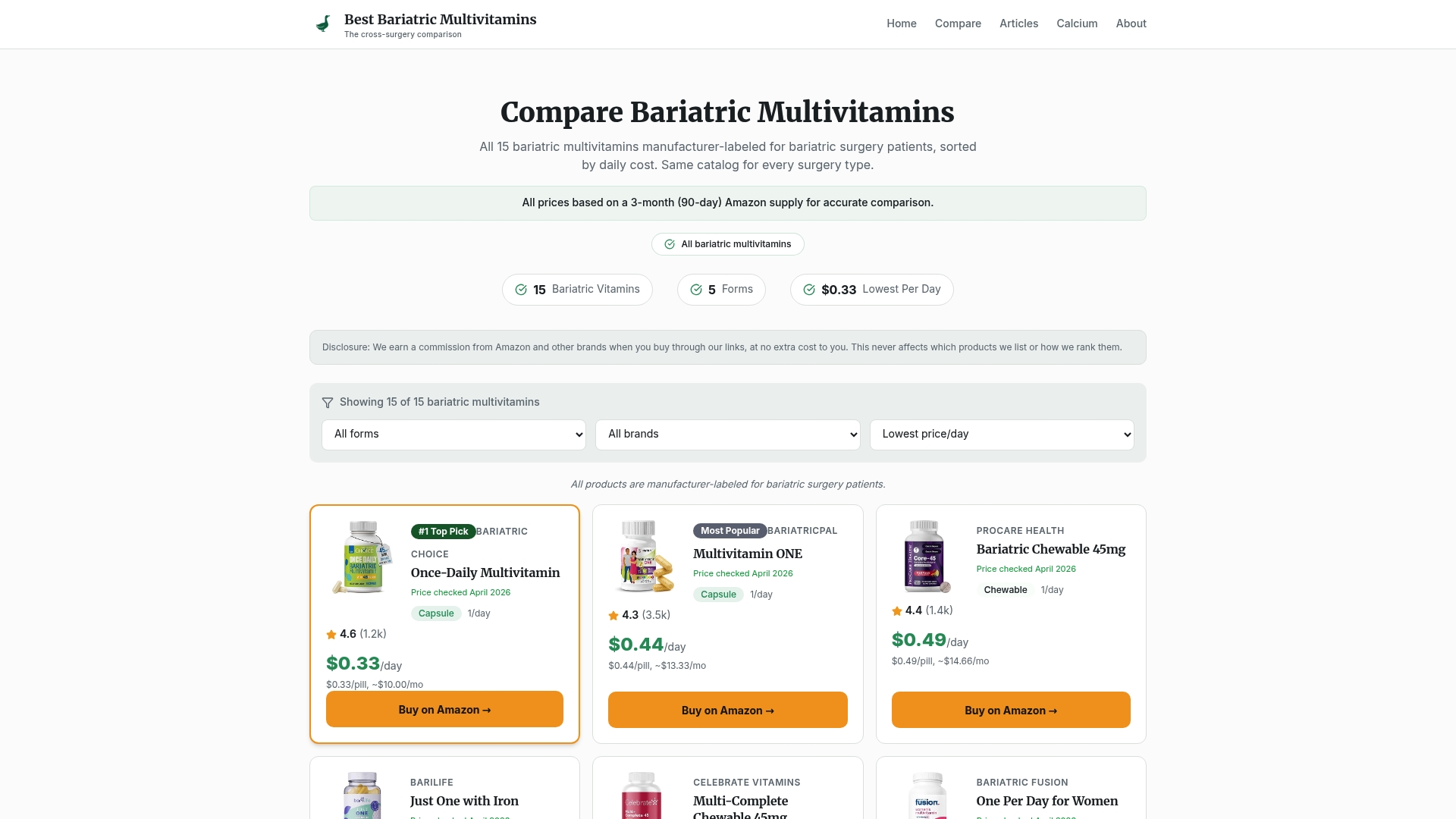
Whether you had gastric bypass, sleeve gastrectomy, or a mini-bypass, you can compare bariatric multivitamin prices side by side and find options that balance both safety and budget. Every recommendation on the site is grounded in ASMBS guidelines and written from real patient experience. You do not have to guess which product fits your needs or do the math alone. Start with the comparison tool, filter by your surgery type, and build a regimen that protects your health without draining your wallet.
Frequently asked questions
Why can’t I just use a standard adult multivitamin after bariatric surgery?
Standard adult multivitamins do not meet the much higher nutrient needs set for post-op bariatric patients, especially for iron, calcium, and vitamin B12, where post-op targets are significantly higher than standard formulations. Using a general multivitamin puts you at real risk of developing deficiencies that can cause lasting health problems.
What’s included in a true cost-per-day calculation for bariatric vitamins?
A real calculation should bundle the cost of your multivitamin, calcium citrate, vitamin D, and any extra iron or B12 based on your lab results and surgery type, because full regimen cost-per-day must include the multivitamin plus all needed add-ons. Pricing only the multivitamin gives you an incomplete and often misleading number.
How much will I usually spend per month on bariatric supplements?
Most bariatric patients can expect to spend between $20 and $60 a month on their core supplement regimen, with monthly costs varying based on brand, surgery type, and whether additional iron or B12 is needed. Choosing a bundled bariatric product can sometimes keep you at the lower end of that range.
Are there ways to lower my bariatric vitamin costs without risking deficiencies?
Yes, you can save by comparing bundled bariatric-specific regimens for value, but always verify that they meet all recommended nutrient targets, because cost savings are only safe when products meet surgery-specific guidelines. Switching to a cheaper option that leaves gaps in iron, calcium citrate, or B12 is not a real saving.
Recommended
- Best Bariatric Multivitamins: Compare 15 Products by Price
- Best Multivitamin After Gastric Bypass Surgery (2026)
- Best Multivitamin After Gastric Sleeve Surgery (2026)
- Does Insurance Cover Bariatric Vitamins? What You Need to Know
- comparison shopping by daily cost
Find your bariatric multivitamin
Compare 15 products by price, surgery type, and iron content.
Compare 15 multivitamins